Writing
← Writing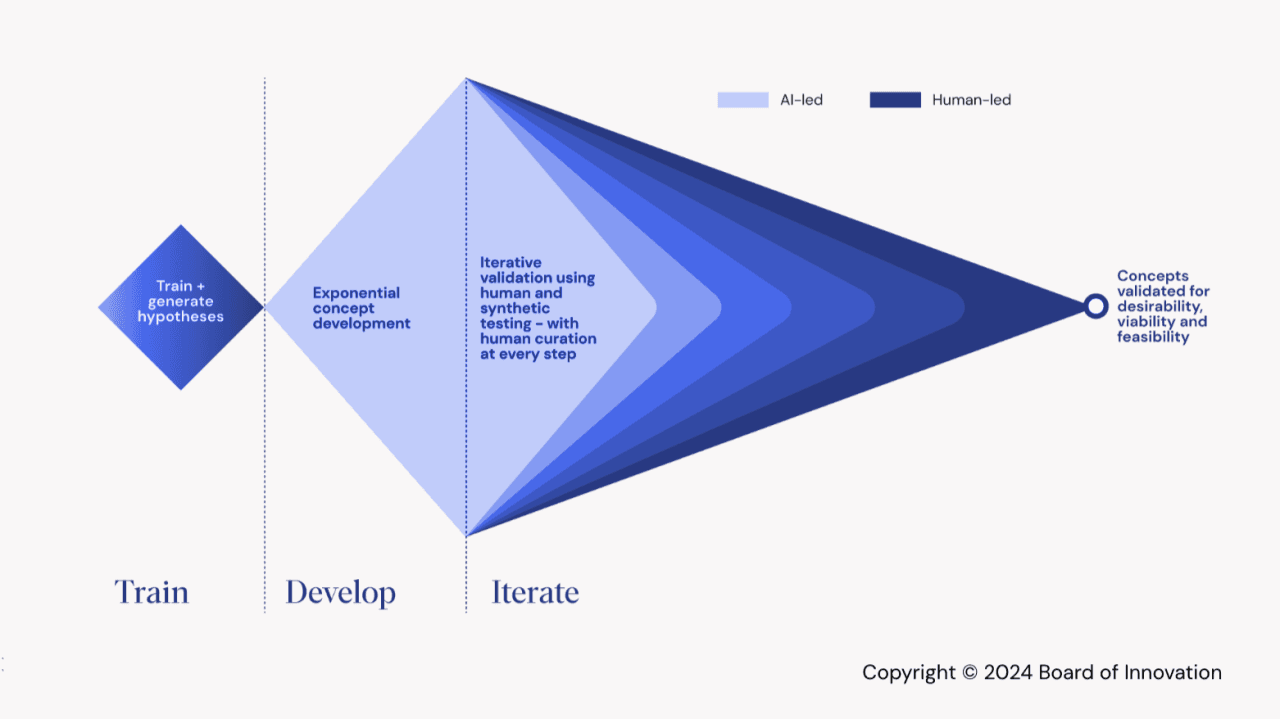
The Stingray Model: Reimagining Innovation in the AI Era
The Stingray Model integrates AI into the core of design workflows, not as a tool, but as a new operating system. Faster ideation, smarter validation, and measurable outcomes without sacrificing creativity or quality.
The Stingray Model, developed by Geoff Gibbins and explored by the Board of Innovation, integrates AI into the core of design workflows rather than treating it as a bolt-on tool. It is a structural change to how innovation teams work.
The traditional Double Diamond moves sequentially. Teams define, then ideate, then test. Progress depends on workshops, and workshops take weeks. The Stingray Model changes the sequence.
Parallel Ideation
In the Develop stage, human designers and AI systems explore hypotheses at the same time. Instead of generating 20 to 30 ideas in a room, AI produces hundreds of categorized, feasibility-checked solutions alongside early prototypes. Teams enter the refinement phase with a pre-screened option set rather than a raw dump of unvetted ideas.
This is a real efficiency gain. The bottleneck in most innovation projects is not generating ideas. It is the time spent evaluating ones that were never viable to begin with.
Hybrid Validation
The Iterate stage pairs AI tools with traditional research methods. AI runs synthetic user interviews, analyzes language patterns, and surfaces insights across diverse user segments. Usability tests and qualitative research run alongside this. Designers get visibility into patterns that human-only teams often miss, particularly from edge-case and underserved user groups.
The result is more perspectives and less guesswork. Not a guarantee, but a structural probability.
Reducing Opinion Bias
Innovation projects frequently stall on internal politics. Someone with seniority favors their idea. Sunk costs distort judgment. The Stingray Model introduces algorithmic prioritization to cut through this.
A product team might evaluate ideas against sustainability, manufacturing cost, technical risk, and brand alignment simultaneously. The AI surfaces a data-weighted shortlist. Decisions still belong to the humans, but the inputs are more balanced.
Time and Cost
Innovation is expensive. The model's proponents point to a manufacturing firm that saved over $2 million in R&D by using AI-powered simulations to catch design flaws before physical prototyping began. Automated documentation is another output, which helps teams avoid repeating mistakes across transitions.
Early adopters report a 68% reduction in time to validation, a 45% increase in successful product launches, and 3x more diverse ideas during ideation. These figures are worth treating with appropriate skepticism until independently validated, but the directional trend is consistent with what faster iteration typically produces.
Flexibility Across Contexts
The model is not built for a single industry. Healthcare teams use encrypted AI tools to process patient data. Consumer brands train AI agents on sales and feedback data to pressure-test product predictions. Regulated industries layer compliance requirements on top without giving up the speed benefits.
The architecture is modular, which makes it easier to start narrow and expand.
Where Designers Fit
The version of AI-augmented work that worries designers is one where the tool displaces judgment. The Stingray Model positions the designer differently: as the person defining criteria, maintaining ethical guardrails, and owning experience quality. AI handles the analysis and scaling work.
Whether that division holds in practice depends on how the model is implemented. But the framing is the right one.